


When purpose meets revenue
- bongiwe53
- Jun 2
- 4 min read
Media entrepreneur and digital strategist TinaShe Makwande urged women entrepreneurs to connect purpose with profit, arguing that sustainable businesses require clear value propositions, diversified revenue streams and the financial discipline needed to keep organisations growing long after the initial passion that inspired them.
Presented during the final session of the fraymedia Foundation Mentorship Booster Programme Skills Development Seminars, TinaShe Makwande challenged journalists, communicators and media founders across Africa to rethink what it means to build sustainable media businesses.
The third and final webinar in the three-part series focused on “Leading the Business” and brought together participants from across the continent to reflect on leadership, sustainability, resilience and long-term growth in media and communications entrepreneurship.
Hosted by fraymedia Foundation CEO Paula Fray, the session formed part of the fraymedia Foundation’s broader effort to support women in media leadership, entrepreneurship and digital communications.
Opening the session, Fray reflected on the central question that had shaped the series over the past three months:
“How do we move from being talented individuals doing good work in journalism or communications or public relations to really building sustainable businesses and long-term relationships that support the organisation?”
Fray said the programme had intentionally moved from helping participants think about how to build businesses, to how to grow them and finally how to lead them.
Makwande, Head of Business, AI and Technology partnerships at Starquo, has extensive experience in digital strategy and media entrepreneurship. He told participants that sustainability remains one of the biggest challenges facing independent media businesses.
“We are fortunate in that the industry or sector that we’re in intersects with a huge part of the population,” he said. “The challenge that we have, and which is probably the reason why most of us are on this call, is the sustainability part. How do we ensure that we can keep our media businesses sustainable? How do we ensure that we can keep lights on inside our offices, inside our newsrooms?”
Throughout the session, Makwande repeatedly returned to the idea that media founders need to understand the deeper reasons driving their work.
“Why do we do what we do? Why are you an entrepreneur? Why are you a leader? And what drives you?”
He asked, arguing that a founder’s personal story and motivation are not separate from business strategy, but rather form the foundation of how audiences, teams and partners understand an organisation.
“The way that you communicate about your business, the way that you talk about your business, determines how your audience receives it,” he noted. “It also determines how they perceive the work that you do, and it almost sets the tone for your team.”
Building businesses rooted in purpose
Using examples drawn from participants and media founders, Makwande highlighted how purpose-driven journalism and communications work often emerges from lived experience, community connection and a commitment to representation.
He spoke about the importance of recognising the emotional and practical realities of entrepreneurship, particularly in independent media spaces where founders are often forced to take on multiple roles simultaneously.
Once founders understand their mission and values, the next step is learning how to translate that purpose into a sustainable business model.
“How does this translate into revenue,” he asked. “How does this become a sustainable model? How does this actually turn into a business?”
Makwande encouraged participants to identify the specific value they bring to audiences, clients and communities and to think carefully about how that value can generate income.
He noted that many journalists and communicators struggle to articulate the commercial value of their work, even when their impact is clear.
Leadership beyond survival
A recurring theme throughout the webinar was the need for media entrepreneurs to move beyond survival mode and begin thinking strategically about long-term growth and leadership.
Makwande emphasised that founders often become trapped in the day-to-day operational pressures of keeping businesses afloat and lose sight of the systems needed for sustainability. He encouraged participants to invest in processes, partnerships and organisational structures that could help their businesses scale over time.
Makwande said resilience in media leadership is not simply about surviving difficult conditions, but about building organisations capable of adapting and evolving.
“Even in moments of difficulty, it’s a little bit easier to navigate because you’re driving with purpose,” he said.
The webinar concluded with reflections on leadership, influence and sustainability, as the fraymedia Foundation wrapped up the first cycle of its Mentorship Booster series.
The programme forms part of the Foundation’s broader work supporting women in media, journalism and communications entrepreneurship across Africa through mentorship, networking and practical business development support.
Fray said the series had shown that many journalists and communicators are searching not only for skills, but for ways to build businesses that are sustainable, resilient and rooted in purpose.
“Building a business is one thing,” she said. “Sustaining it, growing influence, navigating uncertainty and continuing to lead — that is the deeper work.”
Read the full presentation: Lead the Business with TinaShe Makwande
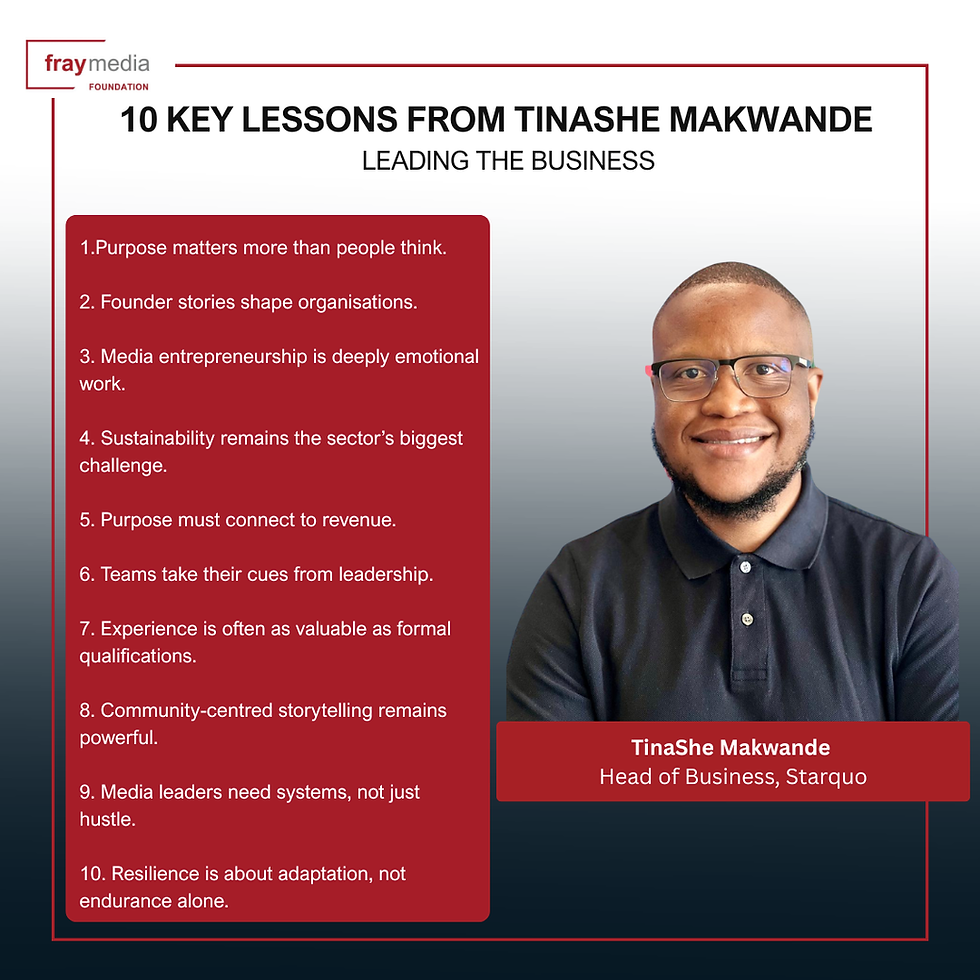
10 Key Lessons from TinaShe Makwande
Practical lessons on leadership, sustainability and building media businesses
1. Purpose matters more than people think
Purpose is not a soft extra but a strategic foundation that shapes culture, communication and long-term resilience.
2. Founder stories shape organisations
A founder’s values and motivations become embedded in the culture of the business itself.
3. Media entrepreneurship is deeply emotional work
Independent media founders often become far more than editors or business owners, and simultaneously act as counsellors, advocates, managers and community organisers.
4. Sustainability remains the sector’s biggest challenge
Find the effective sustainable revenue models in journalism and communications businesses.
5. Purpose must connect to revenue
Passion alone is not enough. Media founders need to understand how the value they create can translate into income and long-term sustainability.
6. Teams take their cues from leadership
Leaders who communicate clearly about purpose and values help create stronger organisational cultures.
7. Experience is often as valuable as formal qualifications
Entrepreneurs practical experience and community engagement shapes their success as much as those with traditional academic pathways.
8. Community-centred storytelling remains powerful
The importance of journalism and communications work that reflects local realities, marginalised voices and community needs is constant.
9. Media leaders need systems, not just hustle
Sustainable businesses require systems, partnerships, structures and strategic planning.
10. Resilience is about adaptation, not endurance alone
Resilience is not simply surviving difficult conditions, but building organisations capable of evolving with changing audiences, technologies and markets.


Comments