


STORIES OF CHANGE: Powerful stories of women who are shaping the future of media and business
Updated: Aug 13

Join us in celebrating and featuring women in media, journalism, and communications business who are breaking barriers, advancing their careers, growing impactful enterprises, and achieving meaningful milestones as they share their stories with us.
fraymedia Foundation is proud to be showcasing dynamic women who are driving innovation, leading change, strengthening ethical and solutions-driven storytelling, and contributing to Africa’s development and media governance landscape.
Click on the dropdown to read the full stories of our changemakers below
STORIES OF CHANGE: In Conversation with Tumi Makgobotloane

What happens when losing a job becomes the beginning of building something of your own? From retrenchment to representation, this story is a reflection on how Tumi Makgobotloane is building a platform for new voices for the Komati Community.
For Tumi, the answer has been Komati News Flash - a community media platform born from a period of uncertainty, shaped by a desire to serve others and strengthened through mentorship, learning and belief in an idea.
Long before she became a media entrepreneur, Tumi had a driving calling.
“I always knew that I wanted to tell stories,” she says.
Her early inspiration came from magazines such as True Love. She would read them page by page, paying close attention to how stories were constructed and how particular words and phrases were used. She would even look up unfamiliar words online and make notes.
After completing her Journalism studies, Tumi entered the media industry through an internship at SABC News. The experience introduced her to storytelling across both television and radio and provided the foundation for what would become her career in media.
But, like many careers, her journey did not follow a straight path.
Turning a setback into an opportunity
One of the defining moments in Tumi’s journey came when she was retrenched and found herself without work.
Unemployment can take a toll on confidence and self-esteem. Rather than allowing the experience to define her, Tumi made a conscious decision to use the time as an opportunity to learn, reflect and rethink what was possible.
“I had to dig deep and reflect on my strengths, while finding creative ways to use my skills to stay focused and not allow the experience of unemployment to consume me,” she recalls.
She enrolled in courses to expand her knowledge, including digital marketing. More importantly, she began to question whether her next step had to be another job.
Instead, she started asking a different question:
What could I create for myself?
That shift in perspective became pivotal.
During this period, Tumi also discovered a growing passion for charity work and community service. She found fulfilment in contributing to others, and this helped her think differently about what she wanted her work to achieve.
A conversation with a friend about opportunities in the media industry eventually planted the seed for what would become Komati News Flash.
Rather than simply looking for employment, Tumi began thinking about creating a media platform of her own.
Giving a community a voice
The idea emerged from her awareness of a community in Mpumalanga and the lack of local stories and information about the area.
At the heart of her thinking was the community’s experience of the Just Energy Transition.
For many years, communities in the area have relied on coal for livelihoods and employment. As South Africa transitions away from coal, residents face uncertainty about their economic futures, employment prospects and livelihoods.
Tumi saw an opportunity for community media to play an important role, not only by reporting on these changes, but by ensuring that the people experiencing them are part of the story.
She began imagining a platform that would represent the community, keep residents informed and create space for stories that might otherwise be overlooked by mainstream media.
That vision became Komati News Flash.
“The change I am most proud of contributing to is creating a platform that gives a community a voice and puts local stories at the centre,” she says.
Although the platform is still young, Tumi sees its potential as much bigger than simply publishing news.
For her, community media can become a vehicle for connection, information, opportunity and empowerment.
From an idea to a living platform
Tumi's entrepreneurial journey received an important boost when she discovered fraymedia Foundation’s EntreprenHer programme in 2025.
At the time, she had already been contemplating creating a printed newspaper for the Komati Village community. When she came across the programme, it immediately caught her attention.
“I had the idea; I just needed that extra push, guidance and support to turn it into something tangible.”
The programme offered more than skills development. For Tumi, it provided an opportunity to test her idea, share it with other women entrepreneurs, receive mentorship and begin seeing herself differently: as an entrepreneur capable of turning an idea into a viable venture.
“What stood out for me was that the programme seemed to recognise the potential in women with ideas and give them the tools, mentorship and confidence to take those ideas forward.”
That support proved transformative.
Tumi ultimately walked away as the 2025 EntreprenHer programme winner, receiving the prize that helped her move Komati News Flash from an idea towards becoming a functioning platform.
“I entered the programme with what was, at that point, essentially a concept, an idea I had been thinking and talking about, and I walked away with something that was beginning to take shape as a living, breathing platform.”
For Tumi, that transformation is one of the most meaningful parts of her journey.
“It reminded me that an idea can start very small, but with the right support, mentorship, resources and belief, it can become something tangible that creates value for others.”
Learning to lead through uncertainty
Building a media venture in an evolving media landscape requires more than an understanding of journalism. It requires adaptability, resilience and a willingness to keep learning.
For Tumi, continuous learning is central to her leadership philosophy.
“I believe that as a leader, it is important to have a spirit of continuous learning.”
She actively seeks opportunities to develop her knowledge, whether through short courses, acquiring new skills or simply finding information that can help her improve.
But she also believes that learning does not necessarily come from people who are older or more experienced.
The rapid evolution of digital media has made young people important sources of knowledge, particularly when it comes to new platforms, technologies and changing patterns of news consumption.
“I believe leadership also means being humble enough to learn from others, regardless of their age or experience.”
Her approach to leadership is rooted in empathy.
“I try to lead with love, empathy and understanding.”
For Tumi, leadership means being able to correct, guide and hold people accountable without diminishing their confidence or sense of possibility.
“It is about grooming people while imparting knowledge, creating an environment where they can learn, make mistakes and grow.”
That philosophy is closely connected to her vision for Komati News Flash.
Building more than a news platform
Tumi's ambition is for Komati News Flash to become more than a source of local news.
She wants it to contribute to economic opportunity in the community, particularly for young people.
Her long-term vision includes creating opportunities for young people to develop skills in media, writing, digital communication and storytelling—skills that can help them navigate an increasingly changing media environment.
“I would like to create employment opportunities in the community, particularly for young people.”
In this way, her vision for community media extends beyond representation. It is also about skills development, employment and creating pathways for the next generation.
The platform has the potential to give young people not only a place to consume information, but a place to learn how information is created and how stories can shape communities.
The power of mentorship
If there is one lesson Tumi repeatedly returns to, it is the importance of mentorship.
She believes having someone to guide, challenge and support you can make a profound difference, particularly when building something from the ground up.
“Mentorship has helped me become more accountable, but it has also taught me how to navigate challenges more effectively.”
For Tumi, mentorship has encouraged her to implement ideas faster, recognise mistakes earlier and confront challenges instead of avoiding them.
It has also given her perspective.
“Sometimes, when you are building something yourself, it is easy to become too close to the problem.”
A mentor can step back from the situation, ask difficult questions and offer a different perspective; something Tumi says has helped her think through solutions and navigate challenges more effectively.
Most importantly, mentorship has contributed to her growth as a leader.
She has become more confident in making decisions, more comfortable with learning and more willing to acknowledge that she does not always have all the answers.
That, she says, is one of the most valuable lessons she will carry forward.
Just start
For young African women considering media entrepreneurship, Tumi's advice is simple:
“Just start.”
She believes ideas become more powerful when they are put on paper and turned into action.
“Do your research, speak to people who have walked the journey before you, ask questions, listen and learn, and then build from there.”
She acknowledges the voices of doubt that can make entrepreneurship feel impossible, the voices that say an idea is too big, resources are insufficient or the timing is wrong.
But her own experience has taught her otherwise.
“Nothing is impossible, and I say that with so much gratitude in my heart.”
Komati News Flash began with a conversation between two friends. Tumi did not have all the answers, resources or certainty she would eventually need.
She had an idea. And she was willing to start.
The EntreprenHer programme helped her see that the idea could become something more. Mentorship helped her navigate the journey. The support and resources she received helped turn the concept into a platform.
Today, Tumi is continuing to build. From being heard to creating space for others
Tumi's story is ultimately about more than overcoming retrenchment or launching a community media platform.
It is about what becomes possible when a setback creates space to rethink what you are capable of building.
Her journey began with a young girl reading magazines and studying the art of storytelling. It continued through journalism, an SABC News internship, retrenchment, upskilling and an unexpected shift from searching for employment to imagining entrepreneurship.
It has now become a mission to tell stories that matter to a community and to create opportunities for others to find their own voices.
Her vision for Komati News Flash is therefore both journalistic and entrepreneurial: to put local stories at the centre while building a platform that can create skills, opportunities and employment for the community it serves.
And she credits fraymedia Foundation’s EntreprenHer programme with helping her take a crucial step towards that vision.
“I am incredibly grateful to fraymedia Foundation and the EntreprenHer programme for believing in my idea and giving me the opportunity to turn a concept into something real.”
Tumi's story is a powerful reminder that change does not always begin with a fully formed business plan, significant resources or a clear roadmap.
Sometimes, it begins with a conversation.
Sometimes, it begins with a setback.
And sometimes, it begins with a simple decision:
Just start.
STORIES OF CHANGE: In Conversation with Sibongile Mabena

Sibongile Mabena is reshaping what community journalism looks like in Bronkhorstspruit. At 35, she has seen growth as a journalist and founder of the Bronkhorstspruit Bulletin, grounded on the contribution to the development of her community. Mabena has worked across mainstream publications including Rekord, Daily Sun and The Tshwane Post. Today, she is also pursuing her LLB through the University of South Africa (UNISA), further deepening her commitment to justice, accountability and community development.
Through the Bronkhorstspruit Bulletin, Mabena is proving that community journalism is not small journalism. It is courageous journalism. It is accountable journalism. And most importantly, it is journalism rooted in the lived realities of the people it serves.
Her story reminds us that change often begins locally, with one determined woman, a platform, and the courage to tell the truth. Her journey is one of purpose, resilience and an unwavering belief that local stories matter.
From law dreams to local headlines
“I initially wanted to be a lawyer,” Sibongile recalls. “But my dad persuaded me to try journalism because I was a bookworm and forever glued to the news.”
Though hesitant at first, she found her calling while studying journalism at the Tshwane University of Technology. Years later, she has no regrets. Her career has spanned reporting and communications, but her heart has always leaned toward community media.
“Even though I’ve worked in mainstream, I always felt like my purpose is in community media,” she explains.
That conviction led to the creation of the Bronkhorstspruit Bulletin; a platform dedicated to amplifying local voices in a town often defined by controversy.
As community newsrooms shrink and resources decline, stories are increasingly lost, underreported or ignored. Mabena’s mission is clear, to highlight pressing issues, give residents ownership of their narratives, and hold institutions accountable.
Navigating backlash in the digital age
Like many journalists, Mabena has had to adapt to a rapidly evolving digital landscape. News is now gathered, processed and shared at unprecedented speed, and with that comes scrutiny.
“Digital media has changed how news are gathered, processed and disseminated. Sometimes when you report on certain issues, there’s backlash,” she says. “And I can’t control how people consume news.”
Reporting within one’s own community can be especially complex. Support can be divided, and criticism can feel personal. Yet Mabena remains grounded.
“The comments get to me sometimes, but I’m not bothered much.”
Sibongile Mabena has also faced gendered assumptions about her leadership.
“Many people think there’s a man behind the brand,” she notes; a misconception she regularly corrects.
Her leadership presence as a woman, challenges lingering stereotypes in a media industry where, as she puts it, “the glass ceiling may be shattered, but the pieces are still there.”
One of her greatest frustrations is content theft on social media. Stories are republished without credit, limiting both recognition and revenue. Despite this, she continues to produce work with integrity and consistency.
Creating impact, one story at a time
For Mabena, impact is measured in voices amplified and doors opened.
“I’m proud that I gave people a platform to tell their own stories in their own voice, because if you don’t tell your story, someone else will.”
Each like, comment and follow is, to her, a sign of connection and trust. Community members have returned to say they gained sponsors or recognition after being featured. Those moments, she says, make the hard work worthwhile.
Her influence extends beyond her own platform. She supplies story leads to mainstream media and connects journalists with local sources. In doing so, she ensures that Bronkhorstspruit’s stories travel beyond its borders.
Leadership with heart
Journalism, Sibongile Mabena believes, requires courage and compassion in equal measure.
“Journalism isn’t easy. It requires a big heart.”
In a shifting media landscape, she anchors herself in resilience. “I constantly have to remind myself that I can be moved but never shaken.”
Her leadership is not loud, it is steady. It is the kind that builds trust over time and refuses to retreat in the face of obstacles.
Advice to the next generation
To young African women entering media and media entrepreneurship, her message is direct:
“There will always be obstacles, but giving up is not an option. Fight for what you believe in, and things always work out.”
It is advice shaped by lived experience, by navigating criticism, gender bias and the daily grind of running a newsroom.
Inspired by women supporting women
Sibongile first encountered the fraymedia Foundation through social media. A post about women in media participating in the EntreprenHER programme caught her attention.
She was particularly inspired by a woman from Mpumalanga who received funding support to help run her newsroom.
“I was intrigued at how the foundation goes out of its way to help women in media,” she says.
For Sibongile, such initiatives represent more than funding, in that they signal belief. Belief in women’s leadership. Belief in community media. Belief in sustainable change.
STORIES OF CHANGE: In Conversation with Anetta Mangxaba

For the leader behind Dizindaba Media, media has always been about more than reporting the news. It has been about visibility, dignity, representation, and creating platforms where communities can see themselves reflected in their own language and lived realities.
Building community media that serves, represents and empowers, Anetta Mangxaba, brings us to her journey into media and journalism.
The Chairperson of the Association of Independent Publishers (AIP), says her journey was shaped by what she witnessed in underserved and rural communities, particularly among isiXhosa-speaking communities whose stories were often overlooked or misrepresented. This motivated her drive "to create platforms that speak directly to our people in their own language and context".
To the creation of Dizindaba Media, she says:
"Our purpose became not only to inform, but also to empower, educate and preserve identity".
According to the Chairperson, stories of resilience, culture, women, youth, faith, education, community leadership, and local development were not receiving the visibility they deserved in mainstream spaces.
Over time, the purpose of Dizindaba Media expanded beyond traditional journalism into building sustainable media businesses and digital storytelling platforms. Currently, the platform is growing in the aims of focusing on youth development opportunities, podcasts, and partnerships that can create real social and economic impact.
"Today, I see media not just as a tool for reporting, but as a vehicle for transformation, skills development, healing, representation, and nation building" says Mangxaba.
Overcoming obstacles in community media
Like many independent and community media organisations, the journey has not been without challenges. Mangxaba notes that building and sustaining independent media in rural and township communities often means operating with limited resources, funding, and infrastructure while still carrying the responsibility of serving communities effectively.
In this position, she has had to wear multiple hats at once, as a journalist, editor, strategist, marketer, event organiser, community mobiliser, while upholding the quality and credibility of the publication.
Instead of allowing these obstacles to become barriers and discouragement, Mangxaba says she uses the challenges as motivation to innovate and diversify.
This led to a stronger focus on digital transition strategies, community partnerships, storytelling services, sponsorship proposals, podcasts, events, and multimedia content that could create pathways toward sustainability. Purpose-driven leadership also became central to the work, rooted in the belief that resilience becomes essential when work is connected to service to people.
"These challenges taught me adaptability, faith, creativity, and the importance of building platforms that are not only impactful, but sustainable for future generations", she says.
Gaining returns in resilience
Among the achievements she is most proud of is helping create visibility and voice for communities often excluded from mainstream conversations. Through community-centred journalism and storytelling, Dizindaba Media has been able to highlight local issues, celebrate grassroots success stories, and promote educational and development initiatives, while amplifying opportunities for women and young people.
Though Mangxaba entered into the media industry unconventionally, without a formal newsroom or traditional media background, she has been able to spear ahead in her aims.
"I had to learn, build and navigate spaces that were often dominated by established structures and gatekeepers", she explains.
Through resilience, purpose and a commitment to serving communities authentically, she was able to grow from "simply wanting to tell stories into holding influencial leadership positions within the industry".
Recognising todays growth and success
Today, Mangxaba serves as Chairperson of AIP, one of the largest independent media organisations in South Africa. She also serves as Co-Chair of the Digital News Transformation Fund, the country’s first initiative of its kind, focused on supporting the sustainability and future of independent media.
For her, these leadership roles represent more than personal achievement.
They reflect what is possible for women, particularly black women and women from underserved communities, to lead, influence and shape the future of media in Africa.
Enhancing indigenous languages and youths
Another important aspect of Mangxaba's work has been creating platforms that embrace indigenous language storytelling and cultural identity through isiXhosa media.
"This has helped communities feel seen, heard, and respected", she says.
A number of young people in South Africa fall behind due to social and economic limitations, and Mangxaba is driven in the aims of closing this gap.
Looking ahead, she hopes to mentor and inspire young people, especially young women, to believe they can enter media, leadership, and entrepreneurship spaces regardless of their background or qualifications.
"Beyond publishing stories, I believe true impact comes from building confidence, representation, opportunities, and sustainable pathways for others to rise," says Mangxaba.
Leadership in an ever-changing industry
In a constantly shifting media landscape, Mangxaba's leadership approach remains grounded in service, vision, and continuous learning. She believes innovation begins with listening, understanding communities and finding meaningful ways to connect storytelling with solutions, development and skills empowerment.
This philosophy has guided her embrace of multimedia storytelling, podcasts, digital media strategies, community engagement, and partnerships that link journalism with social impact.
“Strong leadership is not about individual recognition alone; it is about creating platforms where others can grow, contribute, and discover their purpose,” she says.
Grounded in faith, discipline, and purpose, Mangxaba has found these elements crucial anchors during uncertain seasons, as they continue to guide how she leads and innovates.
Words to the future women leaders
Mangxaba's advice to young African women entering media and media entrepreneurship is clear:
"Never underestimate the power of your voice, your story, or your perspective. Our communities need authentic storytellers who understand the realities on the ground and who are willing to lead with courage and integrity".
She encourages young women to continue learning, invest in their skills, and build sustainable models around their passion by understanding business, partnerships, branding, and financial management.
"Don't wait for permission to start", she continued. "Use the tools and platforms available to you, continue learning, and invest in building your skills consistently".
Media today is no longer limited to the traditional newsrooms, says Mangxaba, highlighting the vast opportunities in digital storytelling, podcasting, content creation, publishing, broadcast and social impact communication.
Mangxaba further encourages young women to build sustainable models around their passion.
"Creativity is important, but sustainability matters too" she says.
Adding that learning about business, partnerships, branding, and financial management is important to grow vision and create long-term impact.
Most importantly, she believes in staying rooted in purpose.
“Challenges will come, but when your work is connected to service and impact, you will find the strength to continue.”
Mangxaba first came to know about fraymedia Foundation through the Association of Independent Publishers and its work supporting meaningful storytelling, journalism development, and socially conscious media initiatives across Africa.
What stood out most was the Foundation’s commitment to using storytelling not only as a communication tool, but as a way to drive dialogue, inclusion, accountability, and social change.
"I was particularly inspired by the Foundation’s focus on empowering journalists, creators, and storytellers who are passionate about community impact and underrepresented narratives," says Mangxaba, adding how strongly aligned these principles are with her own belief that African stories should be told authentically, ethically, and in ways that uplift communities while creating opportunities for future generations.
STORIES OF CHANGE: In Conversation with Mutshidzi Portia Munyai
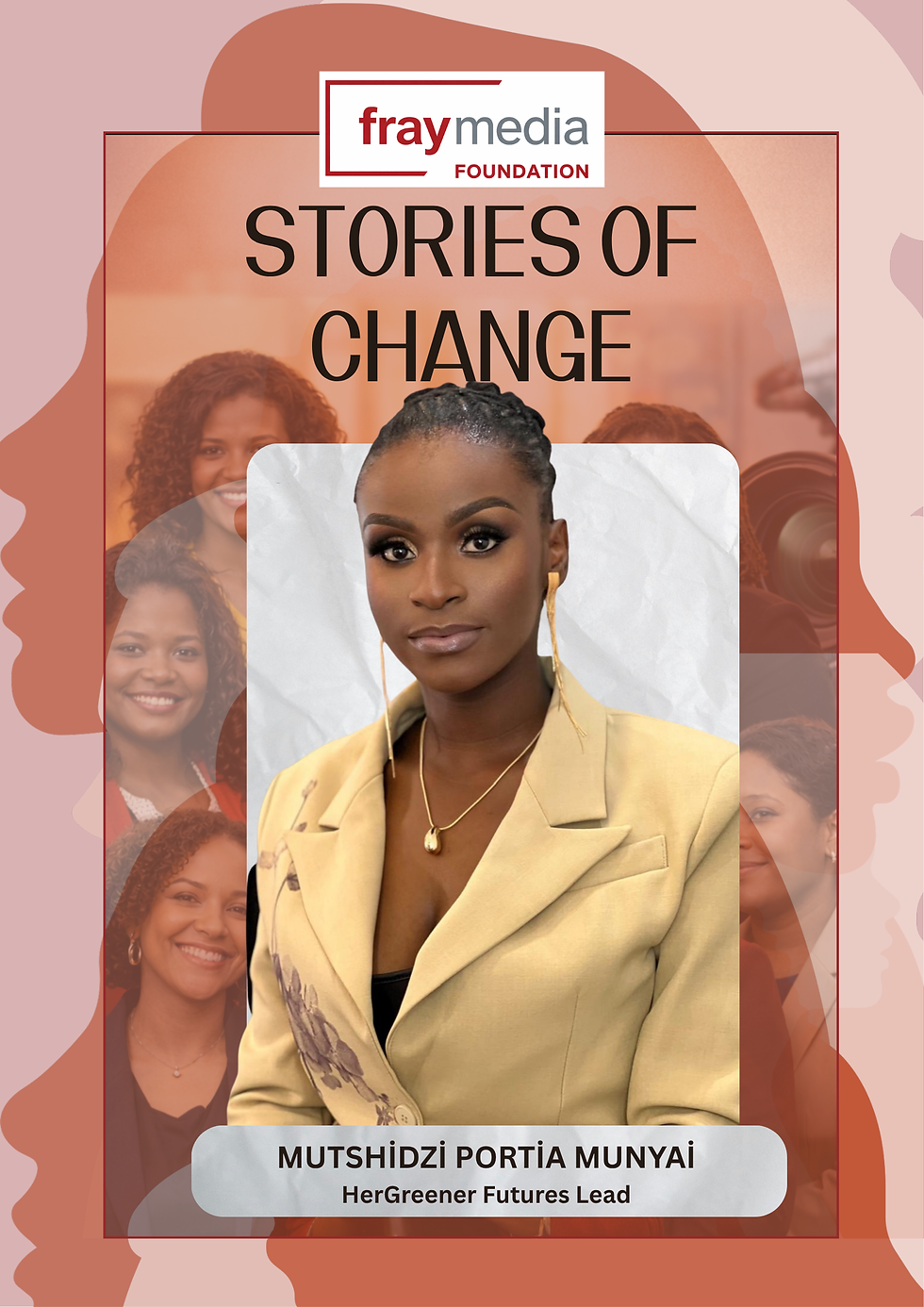
For many, media is a space for storytelling, news, or entertainment. But for one emerging media practitioner from rural South Africa, it is something far more powerful; a tool for development, empowerment, and community resilience.
Mutshidzi Portia Munyai, residing from Limpopo, is founder of Win One Win All organisation, and fellow of the Her Greener Futures initiative. Her disaster preparedness initiative focuses on smallholder and subsistence farmers in rural villages.
Munyai's journey into media began with a simple but profound realisation: communication shapes how people understand the world.
“While studying Media Studies, I became more aware that information can influence how communities make decisions,” she reflects. “Especially in rural areas where access to reliable information is limited.”
This awareness transformed Munyai's perspective. Media was no longer just about content but about access, agency, and impact.
From storytelling to social change
Early hands-on experience at Limpopo Home Cinema, where she worked in continuity, gave her insight into the mechanics of production and the importance of accuracy in storytelling. But it also reinforced something deeper: stories matter, and how they are told can influence lives.
Over time, her purpose evolved beyond pursuing a career in media. Today, she sees communication as a critical bridge between knowledge and communities, particularly for those often excluded from mainstream information systems.
Her work and interests now sit at the intersection of media, environment, and community development, with a strong focus on rural populations.
Through her involvement in initiatives such as the Her Greener Futures: Japan–Africa Women’s Resilience Fellowship, Munyai has been exploring how media platforms, especially community radio, can be used to deliver vital information to smallholder farmers.
Turning challenges into opportunity
Like many young women navigating the media space from under-resourced contexts, her journey has not been without challenges.
Balancing academic commitments, community work, and personal responsibilities has required resilience and determination. Limited access to opportunities in rural areas added another layer of complexity.
But rather than becoming barriers, these challenges became catalysts.
“I chose to look for creative ways to move forward,” she says.
She actively sought out innovation programmes, competitions, and collaborative spaces to test her ideas and build her skills. Her efforts paid off. From being recognised among the top participants in a science innovation programme for her plastic upcycling concept, to placing third in a hackathon with her team.
These experiences not only strengthened her confidence but also reinforced a key lesson: growth often comes from stepping into spaces of challenge and possibility.
Bridging the information gap
At the heart of Munyai's work is a commitment to addressing one critical issue: the information gap facing rural farmers.
Many smallholder farmers rely heavily on seasonal patterns and rainfall, yet lack access to timely and accurate early warning information about climate risks.
Her solution is both simple and powerful: use community radio as a platform to translate scientific information into practical, accessible knowledge.
By connecting environmental data with local communities through trusted communication channels, she aims to help farmers make informed decisions, protect their livelihoods, and strengthen food security.
“I believe that when communities have access to the right information at the right time, they can make better decisions,” she explains.
Leadership through learning and collaboration
In a rapidly evolving media landscape, Munyai sees leadership as a continuous process of learning and adaptation.
“Leadership means being open to change and new ways of communicating,” she says.
Her approach is rooted in collaboration; bringing together diverse perspectives to solve real-world challenges. Participation in hackathons and innovation programmes has shaped her belief that the most impactful solutions often emerge through collective effort.
For Munyai, resilience is equally essential. Staying grounded in purpose, even when faced with obstacles, is what drives long-term impact.
“Leadership is not only about personal success,” she adds. “It’s about creating opportunities and solutions that benefit communities.”
A message to young African women
Her message to other young African women entering media is both encouraging and practical: Your voice matters.
“Media is a powerful platform, and women’s perspectives are important in shaping conversations that affect our societies,” she says.
Munyai encourages young women to remain curious, continuously build their skills, and not wait for perfect opportunities before starting.
“Start small. Work on projects that address local challenges. Build networks and collaborate with others,” she advises.
Above all, she emphasises the importance of staying committed to purpose; using media not just as a career, but as a tool for meaningful change.
Inspired by platforms that amplify change
Munyai's connection to the fraymedia Foundation reflects this same vision.
“What stood out to me is the foundation’s commitment to supporting African media professionals and creating spaces for important conversations,” she says.
She is particularly inspired by platforms that highlight stories of individuals using media to make a difference, spaces that foster knowledge-sharing, collaboration, and innovation across the continent.
As she continues her journey, her mission remains clear: to use media to empower communities, strengthen resilience, and support sustainable development.
Her story is a reminder that impactful media is not only about reaching audiences; it is about reaching communities with purpose, relevance, and care.
And in doing so, she represents a new generation of African women in media, who are innovative, community-driven, and committed to change.
STORIES OF CHANGE: In Conversation with Nontobeko Mtshali

Sometimes the path we never planned becomes the one we were always meant to follow. From plan B to purpose, this story reveals how curiosity, courage and communication shaped a media entrepreneurs journey.
For this media entrepreneur and science communication specialist, the journey into journalism began with an unexpected disappointment. As a learner in Sarel Cilliers High School in Glencoe, she dreamed of becoming an interior designer. Although passionate about art, her school was unable to offer it as a formal subject due to low enrolment. Even an after-school art class, organised by her English teacher, also came to an end when only a handful of learners continued attending.
Determined to pursue her dream, she applied to study interior design at what was then Wits Technikon. She progressed to the final stages of the application process, submitting an art portfolio and completing a practical assessment. Despite demonstrating natural artistic talent, her application was unsuccessful because she lacked the technical drawing and design skills that formal high school art training would have provided.
As she grappled with the disappointment, she found an unexpected source of encouragement in her father. Knowing her strong English marks and her love for writing, he encouraged her to study journalism. He explained that journalism could allow her to combine both interests by becoming an art writer or contributing to home décor magazines, which were thriving at the time. Looking back today, she smiles at how that moment changed everything.
Nontobeko Mtshali now describes journalism as "the best Plan B ever."
Choosing uncertainty
Over the years, her purpose evolved once again. After building a successful journalism career, including serving in a managerial position, she realised she wanted greater ownership of her time and the freedom to design her own life.
"My progression to being a media entrepreneur was influenced by me wanting more control of my time and the freedom to design my life. I was tired of the Sunday Blues."
She recognised a gap where her journalism and science communication expertise could make a difference and decided to establish her own business.
Making that leap was one of the defining moments of her career.
Leaving the certainty of full-time employment without knowing exactly what would come next required courage. Rather than waiting for complete security, she realised that the opportunity she hoped for would only emerge once she committed to the decision.
"I knew something had to give and suspected that the cushion that will catch me, in whatever form, will only appear once I take the leap."
Curiosity became her greatest asset.
"My relentless curiosity helped me navigate this new chapter because I'm learning about running a business as I'm doing it."
She immersed herself in learning through books, YouTube videos, masterclasses, webinars, short courses and business communities, while simultaneously building her business. For Mtshali, entrepreneurship has been an ongoing process of learning, experimenting, making mistakes and growing alongside others who are navigating similar journeys.
"The self-education plus the doing, tripping, learning, growing and meeting people along the way... has helped me tremendously."
Journalism that changes lives
Nontobeko Mtshali's belief in the power of journalism was shaped long before entrepreneurship.
Early in her reporting career, she experienced firsthand how journalism could transform people's lives and two journalistic stories remain especially memorable for her.
One story involved a domestic worker whose identity had been stolen and used to secure substantial bank loans. After months of unsuccessful attempts to resolve the matter through official channels, her story reached the newsroom.
Following the publication of the article, she was issued a new identity number and the banks acknowledged that she was a victim who could not be held responsible for fraudulent loans.
Another story centred on a single mother whose child had been incorrectly denied admission to a school despite qualifying under the education department's own admissions policy. Following media coverage, the department reversed its decision, acknowledged that it had failed to follow its own procedures and admitted the learner.
Reflecting on those experiences, Mtshali realised that journalism could do far more than report events: journalism has the ability to improve people's lives in tangible ways.
"I could contribute to alleviating someone's burden in a significant way."
Democratising knowledge
Today, that same commitment continues through science communication.
As the founder of her own business; Magalela Media, Mtshali sees her work as contributing to the democratisation of knowledge and helping build a more informed citizenry.
"I'm proud to be contributing to the democratisation of knowledge and an informed citizenry."
At a time when misinformation is widespread, she believes accessible and credible information enables people to make better decisions.
"Knowledge enhances our world because if we know better, we do better."
Leading with self-mastery
Nontobeko Mtshali's approach to leadership begins with self-mastery.
"Self-mastery is important. Your ability to manage yourself bleeds into your ability to manage and lead others."
Challenges, she says, are opportunities to build stronger muscles. While difficult experiences may leave scars, they also provide lessons, data and resilience for the future.
"I keep top of mind that the storm I might be in will eventually lead to stronger muscles."
Innovation, in her view, depends on adaptability.
Drawing inspiration from Netflix co-founder Marc Randolph, she embraces the philosophy of remaining committed to the problem being solved rather than becoming attached to a single solution. As technology continues to reshape media, she believes professionals must remain focused on their purpose while allowing their methods to evolve.
Advice for the next generation
Nontobeko Mtshali's advice to emerging journalists is rooted in integrity.
"Keep your word. If someone tells you something is 'off the record', keep it off the record."
For aspiring media entrepreneurs, Mtshali emphasises continuous learning, adaptability and practical business discipline. Alongside developing new skills, she encourages founders to seek professional financial advice early to ensure their businesses remain compliant and sustainable.
She encourages young journalists to pursue the profession because it genuinely inspires them.
"Journalism is demanding, so get into it if it truly lights a fire in your belly."
Mtshali believes continuous learning is no longer optional, particularly for entrepreneurs.
"Having a growth mindset and a thirst for learning is vital."
She also offers practical advice often overlooked by new founders: seek professional financial support early and ensure your business remains compliant as it grows.
A full-circle journey with the fraymedia Foundation
Nontobeko Mtshali's relationship with the fraymedia Foundation reflects the same spirit of growth and lifelong learning.
As a journalism student in 2008, Mtshali reflects on her internship at frayintermedia. Years later, as she embarks on her journey as a media entrepreneur, becoming a fraymedia Foundation Fellow represents what she describes as a "wonderful full-circle moment."
Just as the organisation supported her at the beginning of her journalism career, it is once again providing guidance and mentorship during another significant chapter.
"The fact that I'm a fraymedia Foundation Fellow in my still nascent journey as a media entrepreneur is a wonderful full-circle moment for me because the organisation is doing for me now what it did back then – guiding and mentoring me through a significant career stepping stone."
Nontobeko Mtshali's story reminds us that careers are rarely linear. Sometimes rejection redirects us toward a greater purpose. Sometimes courage means stepping into uncertainty before the path is visible. And sometimes the greatest impact begins with simply being willing to learn, adapt and keep moving forward.


Comments